Monday, March 12, 2012
Occupy Wall Street calls for May Day General Strike!
Occupy Wall Street calls for a General Strike on May 1st - thought I'd share

Wednesday, March 7, 2012
Proposal
For my term paper, I am interested
in writing about suppressed and alternative healthcare techniques and remedies
as well as the idea of food as medicine. The health care systems in the United
States, starting with Kaiser Permanente, became for profit. I would like to
show that they are happy with keeping us “sick” because it makes them money
which is why antidepressants that have been proven to be useless are pushed to
the public anyway.
There
have been various cancer treatments in the past that have been documented and I
would like to delve deeper to seek the truth to the works of rumors as in Royal
R. Rife and his electromagnetic frequencies and more recent ones in Gregg
Braden and the “ether field,” along with researchers from the University of
Alberta, Canada as well as UCLA. I’m sure I will uncover more as research moves
forward.
Foods
also have documented powerful remediation effects such as lemons, cayenne
pepper, and juicing.
I
would like to discuss with you further to get a better heading on this as I
changed topics because my original was too technical for me.
Snow Day !!!!!
1. What is your definition of social sustainability?
Social sustainability to me is a societal structure that gives opportunity to all who seek it along with fair and equitable treatment. It is a system which preserves our resources and our populations.
2. In your own words what is social justice?
Social justice is when justice has been served to people who have been wronged, typically by business, and it has come to correlate itself with environmental issues as those are normally the most immediate and imaginable threats. Social justice tends to be brought about to grassroots activism and local involvement.
3. What is the biggest lesson you've learned from this class so far this semester?
The biggest lesson I've learned from this class so far is how difficult a time some people have discussing issues that have stigma attached to them. There have been multiple classes where some people have not said one word.
4. What question(s) would you like us to answer next semester?
Ohhh, Ty just clarified this for me. I think you mean for the next part of the semester? It would be good to get into the roots of racism. When did it start? Is it determinable or has it always been around?
Social sustainability to me is a societal structure that gives opportunity to all who seek it along with fair and equitable treatment. It is a system which preserves our resources and our populations.
2. In your own words what is social justice?
Social justice is when justice has been served to people who have been wronged, typically by business, and it has come to correlate itself with environmental issues as those are normally the most immediate and imaginable threats. Social justice tends to be brought about to grassroots activism and local involvement.
3. What is the biggest lesson you've learned from this class so far this semester?
The biggest lesson I've learned from this class so far is how difficult a time some people have discussing issues that have stigma attached to them. There have been multiple classes where some people have not said one word.
4. What question(s) would you like us to answer next semester?
Ohhh, Ty just clarified this for me. I think you mean for the next part of the semester? It would be good to get into the roots of racism. When did it start? Is it determinable or has it always been around?
Snowball Effect - Class 5 (2/15/12)
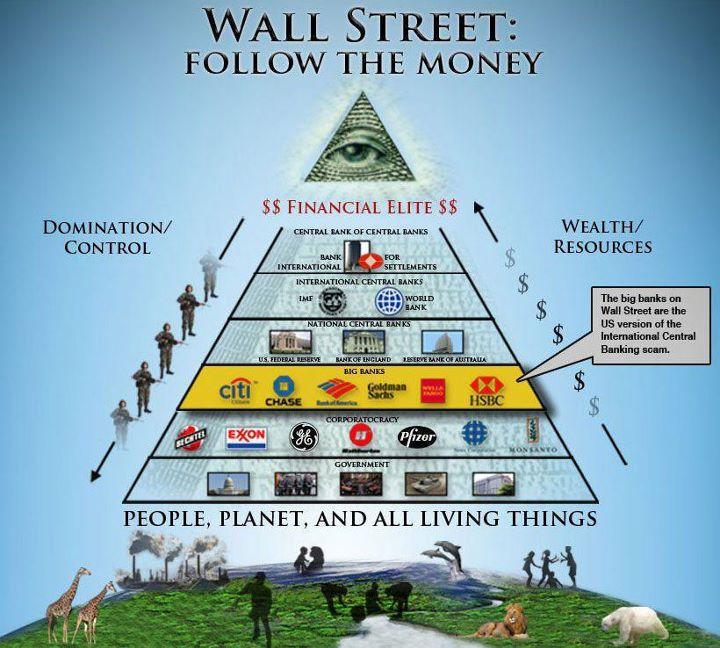
During this class, we started out with the discussion of Snowball and kind of summarizing what its about since we were going to be watching it. We then got into a discussion on capitalism and economies which are driven forward by risk management, and bottom-line profit. Capitalism is based on infinite expansion but the problem with that is that the world has scarce resources so the United States' solution is to create perpetual war to feed our "war machine" that began during WWII to feed its exploitative, imperialistic agenda. The capitalist tower was brought up in class which I had not seen before, but I confused it with a pyramid diagram I had recently seen, both of which are below. They are based on control by manipulation and in this case what they manipulate is the money. Since the creation of the Federal Reserve in 1913, the US dollar has lost over 90% of its value with $1 today being equal to less than $0.10 in 1913 thanks to fractional reserve banking and inflation.

The Snowball Effect had stark similarities to From the Ground Up in how those in authority treated the group at risk in a manner that lacked respect and was condescending. They basically told outright lies; specifically what is brought to mind is the top dog of Snowball lying to children saying that the reclaimed water was completely safe and the snow made from it could even be eaten and also the worked from the water treatment plant who said the water was the same as other water because, wait for it, it looks the same! Of course when asked if he would drink it he basically said he wouldn't be caught dead drinking that water. The whole situation reminds me of the case studies in the book where they try to convince the people it is economically better for them if they just allow it to happen, but its all just lies, the town actually prospered more when there were bad snow years and this was likened to the roads being clear and people being able to go to town to shop. I was glad to hear the opinion's of the old couple in the back because they made great points and the wife basically summarized the premise of From the Ground Up during her little speech. I guess its just good to know there are others out there who understand the plight.
The Snowball Effect had stark similarities to From the Ground Up in how those in authority treated the group at risk in a manner that lacked respect and was condescending. They basically told outright lies; specifically what is brought to mind is the top dog of Snowball lying to children saying that the reclaimed water was completely safe and the snow made from it could even be eaten and also the worked from the water treatment plant who said the water was the same as other water because, wait for it, it looks the same! Of course when asked if he would drink it he basically said he wouldn't be caught dead drinking that water. The whole situation reminds me of the case studies in the book where they try to convince the people it is economically better for them if they just allow it to happen, but its all just lies, the town actually prospered more when there were bad snow years and this was likened to the roads being clear and people being able to go to town to shop. I was glad to hear the opinion's of the old couple in the back because they made great points and the wife basically summarized the premise of From the Ground Up during her little speech. I guess its just good to know there are others out there who understand the plight.
Chapter 3 Class 3 (2/1/12)
Chapter 3 was extremely boring and dry. It discussed several studies whom had used the same information with the possibility of different methodology and how they ended at differing results. The chapter shares the siting process and shows a lot of support for it being a racist siting process, but explains that proving racism is grueling due to its abstract nature.
In class we had a great discussion touching on many subjects such as opportunity, equity, class, and distribution of wealth. Ty and yourself had a pretty heated debate over Hawaiians and Native Americans and the treatment that "we" have shown them and how they react because of it. We have taken vast quantities of resources from these people, including land, and we set up rules, regulations, laws, and policies that benefit us and basically ignore them. There is a disproportionate distribution of wealth and those without it have little opportunity available to them to change that. Banks give loans to people with money because they are out to make a profit and they want to make safe investments. People in lower classes are basically trapped there and defined by it, much like those in India's caste system.
In class we had a great discussion touching on many subjects such as opportunity, equity, class, and distribution of wealth. Ty and yourself had a pretty heated debate over Hawaiians and Native Americans and the treatment that "we" have shown them and how they react because of it. We have taken vast quantities of resources from these people, including land, and we set up rules, regulations, laws, and policies that benefit us and basically ignore them. There is a disproportionate distribution of wealth and those without it have little opportunity available to them to change that. Banks give loans to people with money because they are out to make a profit and they want to make safe investments. People in lower classes are basically trapped there and defined by it, much like those in India's caste system.
Tuesday, March 6, 2012
Class 2 Chapter 2 (1/25/12)
There are a multitude of similarities within the stories of Kettleman City, Buttonwillow, and Chester. All their struggles began by meeting disregard and ridicule before confrontation. The citizens of Chester realized like the others that the law is structured in a way that is not always "right" as you would like to think. The most important changes occurred at the local levels and I feel this is the important lesson to take from it; true change begins from the bottom up, its much harder to go from the top down.
During class we reviewed the first week's discussion a bit going over what sustainability meant and moving onward to the socially constructed forms of oppression, mainly racism, sexism, and classism. It is much easier to control a population when the population does not see itself as a whole and these forms of oppression serve to stratify and divide the population. A vast majority of people are blind to the big picture and they are in bliss in their ignorance. Obama had just given his State of the Union speech and addressed some key issues including the war, energy, the income inequality and the income gap, and of course the state of the economy. We watched DemocracyNow! for a bit which mostly recapped the SotU and there was a small segment on Ralph Nader as well. During the class we also touched on the military-industrial complex which accounts for a huge portion of our GDP so flat-out stopping our international conflicts isn't that simple. It seems that our country is structured for war and like previous Justice Movements have shown us, top down change is hard to come by.
During class we reviewed the first week's discussion a bit going over what sustainability meant and moving onward to the socially constructed forms of oppression, mainly racism, sexism, and classism. It is much easier to control a population when the population does not see itself as a whole and these forms of oppression serve to stratify and divide the population. A vast majority of people are blind to the big picture and they are in bliss in their ignorance. Obama had just given his State of the Union speech and addressed some key issues including the war, energy, the income inequality and the income gap, and of course the state of the economy. We watched DemocracyNow! for a bit which mostly recapped the SotU and there was a small segment on Ralph Nader as well. During the class we also touched on the military-industrial complex which accounts for a huge portion of our GDP so flat-out stopping our international conflicts isn't that simple. It seems that our country is structured for war and like previous Justice Movements have shown us, top down change is hard to come by.
Class 1 Chapter 1 (1/19/12?)
Our first class was a pretty good icebreaker for the course and for the class as a group. It was a day of international protest on internet censorship and it spread awareness on SOPA/PIPA (see video at bottom for information) and partially in solidarity with the protest class was ended early. During the class we discussed what "sustainability" meant to us and we came up with some pretty good concepts such as: triple bottom line+politics, cradle-2-cradle, alternative/renewable energy, accountability, appropriateness, repair/reduce/reuse/recycle, and more. We then dove further into a PIPA/SOPA/ACTA discussion which was fairly informational.
In the preface, introduction, and Chapter 1 of From the Ground Up, we learnt about Kettleman City and their fight against Chemical Waste Management who wanted to expand their dump site in Kettleman City's whereabouts. We learnt how the vast majority of environmental hazards are near communities dominated by minorities or colored and low-income families. The book discussed the "tributaries" that contributed to the Environmental Justice Movement which included leaders from the Civil Rights Movements, the Labor Movement, and of course academia. The movements built off each others' strengths and their efforts are replicated today in the Occupy Movement in taking a multifaceted approach with both public demonstrations and legal action. These tributaries led to national reform through structural changes in policy.
In the preface, introduction, and Chapter 1 of From the Ground Up, we learnt about Kettleman City and their fight against Chemical Waste Management who wanted to expand their dump site in Kettleman City's whereabouts. We learnt how the vast majority of environmental hazards are near communities dominated by minorities or colored and low-income families. The book discussed the "tributaries" that contributed to the Environmental Justice Movement which included leaders from the Civil Rights Movements, the Labor Movement, and of course academia. The movements built off each others' strengths and their efforts are replicated today in the Occupy Movement in taking a multifaceted approach with both public demonstrations and legal action. These tributaries led to national reform through structural changes in policy.
Subscribe to:
Posts (Atom)